Factory-Engineered Pallet Storage Systems
Engineered in compliance with European Standard EN 15512, ANSI MH16.1, and ISO 9001 quality management protocols. Every bay delivers certified yield resilience, precise connection locking, and anti-collapse geometry.
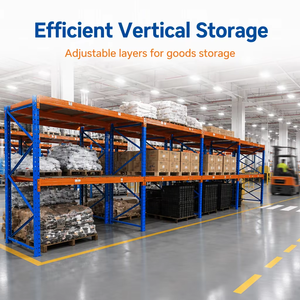
OEM/ODM Heavy-Duty Selective Pallet Racking System
- Steel Grade: Q235B / S235JR Hot-Rolled
- Unit Load Rating: 1,000 - 4,500 kg / Beam Level
- Pitch Adjustment: 50mm / 75mm Precision Hole
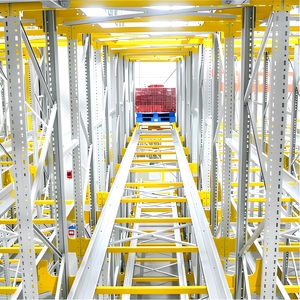
Double Deep Heavy-Duty 5-Layer Warehouse Rack
- Elevation: Up to 12 Meters (Rigid Tie Bars)
- Capacity: 3,500 kg / Level Distributed
- Aisle Space: Reduces Aisles by 35%
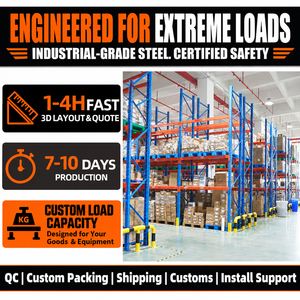
Push Back Heavy-Duty Steel Cart Storage System
- Storage Depth: 2 to 6 Pallets Deep (LIFO)
- Cart Carrier: Heavy Guage Nested Bearings
- Inclination: Calibrated Gravity Incline Rail
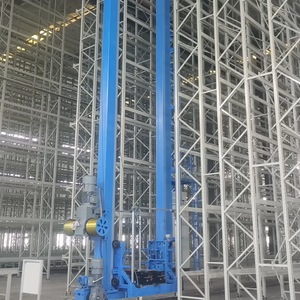
High-Capacity Q235 Steel Pallet Storage Racking
- Tensile Strength: 370 - 500 MPa Verified
- Safety Factor: 1.5 Design Working Limit
- Corrosion: Anti-Rust Epoxy Powder Coat
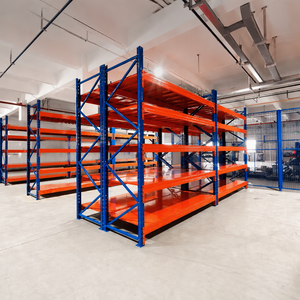
Industrial Selective Pallet Racking Shelf System
- Upright Profile: Omega 80/90/100/120 Type
- Beam Connector: 3/4/5 Claws Riveted Locks
- Certification: CE, ISO9001, AS4084-2012
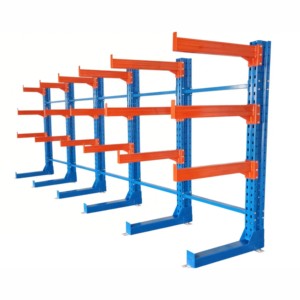
CE Certified Heavy-Duty Cantilever Arm Racks
- Application: Pipes, Timber, Extruded Metals
- Arm Geometry: Foldable Shock-Absorbing Arm
- Column Base: Welded High-Moment I-Beam Base
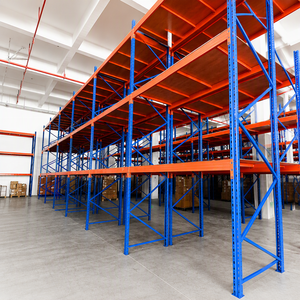
Customizable Heavy-Duty Steel Warehouse Racks
- Structural Beam: Box Beam & Step Beam Options
- Decking Support: Wire Mesh Deck / Steel Plates
- Aisle Compatibility: Reach Truck, Counterbalance
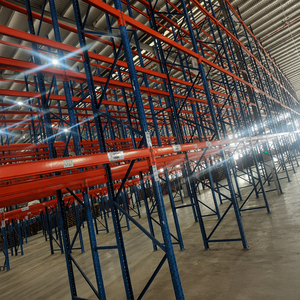
Durable Industrial Warehouse Selective Pallet Racks
- Direct OEM: Custom Punching & Paint Matching
- Anchoring: M12-M16 High-Shear Expansion Bolts
- Bracing Type: Triangulated Bolted K/X Bracing
The Mechanics of CE Certification in Pallet Racking
Understanding the rigorous compliance benchmarks under Construction Products Regulation (CPR 305/2011/EU) and EN 15512:2020 design rules for steel static storage systems.
Procuring heavy-duty warehouse pallet storage systems is not merely a purchase of formed steel; it is a structural engineering procurement governed by stringent safety coefficients, dynamic cyclic loading considerations, and legal liability frameworks. In the European Union and jurisdictions adhering to European Committee for Standardisation (CEN) standards, compliance is bound by the mandate of the CE Marking under EN 1090-1 (Execution Class EXC2 or EXC3) and the structural calculation principles stipulated under EN 15512:2020+A1:2022.
Unlike static buildings, industrial pallet racking systems present unique structural vulnerabilities: their open thin-walled cold-formed steel sections are susceptible to local buckling, distortional buckling, and flexural-torsional buckling. Furthermore, beam-to-column connections act as semi-rigid joints with complex rotational stiffness curves ($C_d$). An authentic CE-certified manufacturing factory executes comprehensive destructive lab testing for every profile configuration—including stub column tests, upright-to-beam connection shear tests, and looseness tests—to establish the actual empirical values that feed the Limit State Design (LSD) mathematical models.
| Evaluation Parameter | EN 15512:2020 (CE Directives) | ANSI MH16.1 (R-Mark / USA) | Generic Non-Certified Racks |
|---|---|---|---|
| Steel Grade Verification | Certified S235JR / S355JR / Q235B (3.1 Mill Certificate) | ASTM A1011 / A36 / Structural Quality | Uncertified commercial re-roll scrap |
| Partial Safety Factor ($\gamma_M$) | $\gamma_{M0} = 1.0$, $\gamma_{M1} = 1.1$, $\gamma_{M2} = 1.25$ | LRFD $\phi = 0.90$ / ASD $F.S. = 1.67$ | Arbitrary or untested nominal factors |
| Beam Deflection Tolerance | $L / 200$ strictly enforced under working load | $L / 180$ maximum allowable under ASD | Often exceeds $L / 120$, risking dislodgement |
| Beam Locking Pin Resistance | Resists min. $5.0\text{ kN}$ upward vertical uplift | Safety clips rated for $1,000\text{ lbs}$ ($4.45\text{ kN}$) | Flimsy wire clips (< $1.5\text{ kN}$ uplift) |
| Seismic Plastic Dissipation | Design per EN 16681 with ductility checks | ASCE 7 & FEMA 460 response modification | Non-engineered; zero seismic modeling |
| Traceability & DoP | Mandatory Declaration of Performance (DoP) | Manufacturer R-Mark Certificate | None provided; untraceable batch origins |
Why Global Supply Chains Partner With Our Manufacturing Plants
Integrating over 80 years of structural engineering heritage, automated continuous roll-forming lines, and triple certified QA/QC protocols.
Automated Precision Roll-Forming
Operating 24-station automated cold roll-forming production lines with in-line computerized optical punch centers. Profile hole pitches maintain a laser-monitored tolerance within ±0.15mm over a 12-meter upright length, guaranteeing seamless beam engagement and eliminating residual structural prestress.
Robotic Laser Welding & CWB Division 3
All beam connectors and structural base plates are welded via robotic ABB MIG welding cells. Calibrated according to AWS D1.1 and holding CSA W47.1 Division 3 structural fusion welding certifications, our plants eliminate cold laps and incomplete penetration defects at high-stress connector joints.
Certified High-Yield Steel Coils
Direct mill sourcing of prime Q235B and Q355B structural coil grades with verified chemistry and mechanical properties. Material batches receive spectrographic metallurgical analysis and Charpy V-notch impact testing to ensure zero brittle fracture risk in sub-zero cold-storage (-30°C) installations.
Multi-Standard Global Certification
Holding active Factory Production Control (FPC) audit certifications under EN 1090, ISO 3834-2 welding quality, ISO 9001, ISO 14001, and compliance with the Rack Manufacturers Institute (RMI) R-Mark standard. One single enterprise manufacturing partner meets North American, European, and Australasian engineering codes.
Eco-Friendly Electrostatic Coating
State-of-the-art automated Swiss Gema powder coating lines with a 7-stage non-phosphate silane pre-treatment tunnel. Yields salt spray resistance exceeding 500 hours (ASTM B117) and film hardness >2H, ensuring superior scratch and impact resilience against continuous forklift interactions.
Comprehensive Seismic Modeling
Dedicated structural R&D engineering divisions operating modal analysis software (ANSYS, SAP2000). Every rack project is custom-designed based on project-specific Ground Acceleration coefficients ($S_s, S_1$), soil site classes, and ductility capacities, with available wet-stamped engineering calculations.
Future Procurement Trends for Warehouse Pallet Racking
How supply chain directors, industrial EPC contractors, and 3PL procurement executives are recalibrating their warehouse equipment acquisition strategies.
Total Cost of Ownership vs. Initial Capex
Procurement teams are shifting from evaluating price-per-kilogram of raw steel to assessing lifecycle maintenance and reconfiguration costs. Racks built to strict EN 15512 standards show a 68% lower rate of upright replacement over an 8-year operational span due to superior steel ductility, high-elasticity beam connections, and robust impact resilience.
Carbon Footprint & CBAM Compliance
With the European Union Carbon Border Adjustment Mechanism (CBAM) fully phased in, cross-border buyers demand certified Environmental Product Declarations (EPD). Modern factories utilize electric arc furnace (EAF) steel coils and green hydrogen-powered finishing processes to deliver transparent Scope 1, 2, and 3 emissions tracking.
Modular Hybridization Readiness
Forward-thinking logistics facilities are procuring static selective racks designed with structural headroom to accommodate future conversion into automated 2D shuttle systems, pick towers, or Autonomous Mobile Robot (AMR) top-running decks without requiring total teardown and re-permitting.
Stringent Anchor Permitting Audits
Municipal building code inspectors and insurance underwriters (e.g., FM Global) enforce strict structural anchoring criteria. Buyers now mandate pre-engineered anchor calculation packets demonstrating compliance with EN 1992-4 (Eurocode 2 Part 4) concrete breakout and pull-out limits for cracked concrete slabs.
Decentralized Nearshore Inventory Buffers
To mitigate volatile maritime freight disruption, strategic procurement leverages factory-direct programs that partner with regional quick-ship distribution hubs. Holding standard upright profiles and boxed beams regionally ensures 72-hour replenishment for urgent facility expansions.
Technological & Structural Development Trends
Next-generation mechanical advances transforming industrial static storage into intelligent, automated, and self-monitoring intralogistics structures.
AS/RS & High-Tolerance Fabrication
Automated Storage and Retrieval Systems (AS/RS) require mechanical rack tolerances defined under FEM 9.831 and EN 15620 (Class 100 to Class 400). Modern manufacturing utilizes robotic 3D coordinate-measuring inspection tables, holding sway and plumb tolerances below 1:1000 to prevent automated crane head collisions at travel speeds exceeding 4 m/s.
IoT Structural Health Monitoring (SHM)
The integration of low-power triaxial MEMS accelerometers, optical strain gauges, and wireless telemetry directly into critical upright frames. Real-time dashboards instantly register forklift micro-impacts, continuous frame tilt, and localized overload events, triggering automated alerts before critical Euler buckling failure occurs.
Base Isolation & Dissipative Seismic Tech
Pioneered by advanced seismic engineering systems, base isolation friction pendulum bearings and replaceable sacrificial energy-dissipating dampers decouple the rack frame from severe ground acceleration ($PGA > 0.4g$). This protects high-value inventory (e.g., pharmaceuticals, electronics, fine wines) from tipping off beams during major seismic events.
Frequently Asked Questions by Industrial Buyers
Authoritative technical answers to common queries regarding standards, quality assurance, logistics, and certification validity.
What specific documentation proves a pallet rack factory is truly CE certified?
A legitimate CE certification for industrial pallet storage systems requires two essential legal documents under EU Regulation 305/2011: (1) A Certificate of Conformity of the Factory Production Control (FPC) issued by an accredited European Notified Body under standard EN 1090-1 for structural steel components, and (2) A manufacturer-issued Declaration of Performance (DoP) citing EN 15512 or EN 1090, which references execution class (typically EXC2), raw material yield grades (e.g., S235JR or S355JR), weldability, and corrosion protection. Generic ISO 9001 certificates or test lab reports from unauthorized agencies do not constitute legal CE compliance.
How does Chinese Q235B steel compare structurally with European S235JR?
Under the international cross-reference standards (EN 10025-2 vs. GB/T 700), Q235B and S235JR are functionally equivalent structural carbon steels. Both require a minimum yield strength ($R_e / f_y$) of 235 MPa for thicknesses up to 16mm, and tensile strengths ranging between 360–510 MPa. Grade 'B' in Q235 and 'JR' in S235 both mandate guaranteed Charpy V-notch longitudinal impact energy absorption of ≥27 Joules at room temperature (+20°C). Verified export factories provide 3.1 Mill Test Certificates (MTC) proving compliance with both chemical composition limits (Carbon ≤0.20%, Sulfur ≤0.045%, Phosphorus ≤0.045%) and mechanical ductility thresholds.
Why must structural pallet rack calculations be project- and site-specific?
Racks cannot safely be sold using a universal "load table" because capacity is an interdependent function of five variables: (1) Bottom beam elevation (clear floor distance to the first beam level), which governs the unbraced buckling length ($L_{cr}$) of the upright columns; (2) Building slab concrete compressive strength ($f'_c$) and slab thickness, determining anchor embedment capacity; (3) Dynamic lift equipment interaction (counterbalance vs. turret trucks); (4) Local seismic design category ($S_{DS}$ / Ground Peak Acceleration); and (5) Vertical flue space requirements for NFPA/EN sprinkler fire suppression. Every CE-compliant installation requires a tailored structural calculation sign-off.
What is the difference between cold-formed roll-formed rack and structural channel rack?
Roll-formed pallet racking utilizes cold-rolled sheet steel formed into multi-bend open profiles (such as 8-bend or 10-bend Omega sections). It offers high strength-to-weight efficiency, teardrop or slotted adjustable beam connections without bolts, and cost-effective shipping. Structural pallet rack uses hot-rolled C-channels and structural I-beams bolted together. While heavier and higher in capex, structural channel rack provides exceptional impact resistance against heavy industrial forklift collisions, making it the preferred standard for food freezer warehouses, lumber yards, and high-turnover cross-dock facilities.
How do modern pallet rack factories prevent galvanic and environmental corrosion?
Protection begins with multi-stage chemical surface conversion. Automated production lines subject cold-rolled profiles to alkaline degreasing, iron phosphating or zirconium-based nanotechnology etching, deionized water rinsing, and oven drying. An electrostatically applied polyester or epoxy-polyester thermosetting powder coat is then cured at 180°C–200°C, yielding a uniform dry film thickness (DFT) of 60–90 μm. For outdoor yard storage or corrosive chemical settings, components are processed via hot-dip galvanization per ISO 1461, achieving a minimum zinc coating thickness of 55–85 μm.
What are the standard international packaging and container loading protocols for racks?
To avoid transit bending and surface abrasions across multi-week ocean freight voyages, factory export standards require: (1) Upright frames packaged flat with high-strength PET/steel strapping, protective corrugated edge protectors, and integrated timber dunnage skids for forklift offloading; (2) Beams bundled in matched pairs with connector ends wrapped in bubble film to prevent ear tangling; (3) Small hardware (safety pins, wedge anchors, shims, row spacers) crated in seaworthy fumigated wooden boxes; and (4) Container load optimization plans modeled via 3D packing software to maximize 40ft High Cube container cube utilization without exceeding axle road weight restrictions.