Procurement Intelligence Frequently Asked Questions: Steel Rack Column Guards
Direct answers to the most common engineering, installation, and compliance questions asked by global supply chain buyers.
What height should a steel rack column guard be according to RMI and industry standards?
RMI (Rack Manufacturers Institute) and ANSI MH16.1 Section 8.4.2 recommend protecting the lower section of upright frames where the vast majority of equipment collisions happen. In practice, the industrial standard height is 12 inches (305 mm) to 24 inches (610 mm). High-velocity grocery, 3PL, and retail distribution centers standardize on 18-inch or 24-inch guards because modern narrow-aisle reach trucks have outrigger wheels and heavy load backrests that make contact higher up than traditional sit-down counterbalanced trucks.
Why do floor-anchored steel column guards frequently crack concrete slabs, and how can that be avoided?
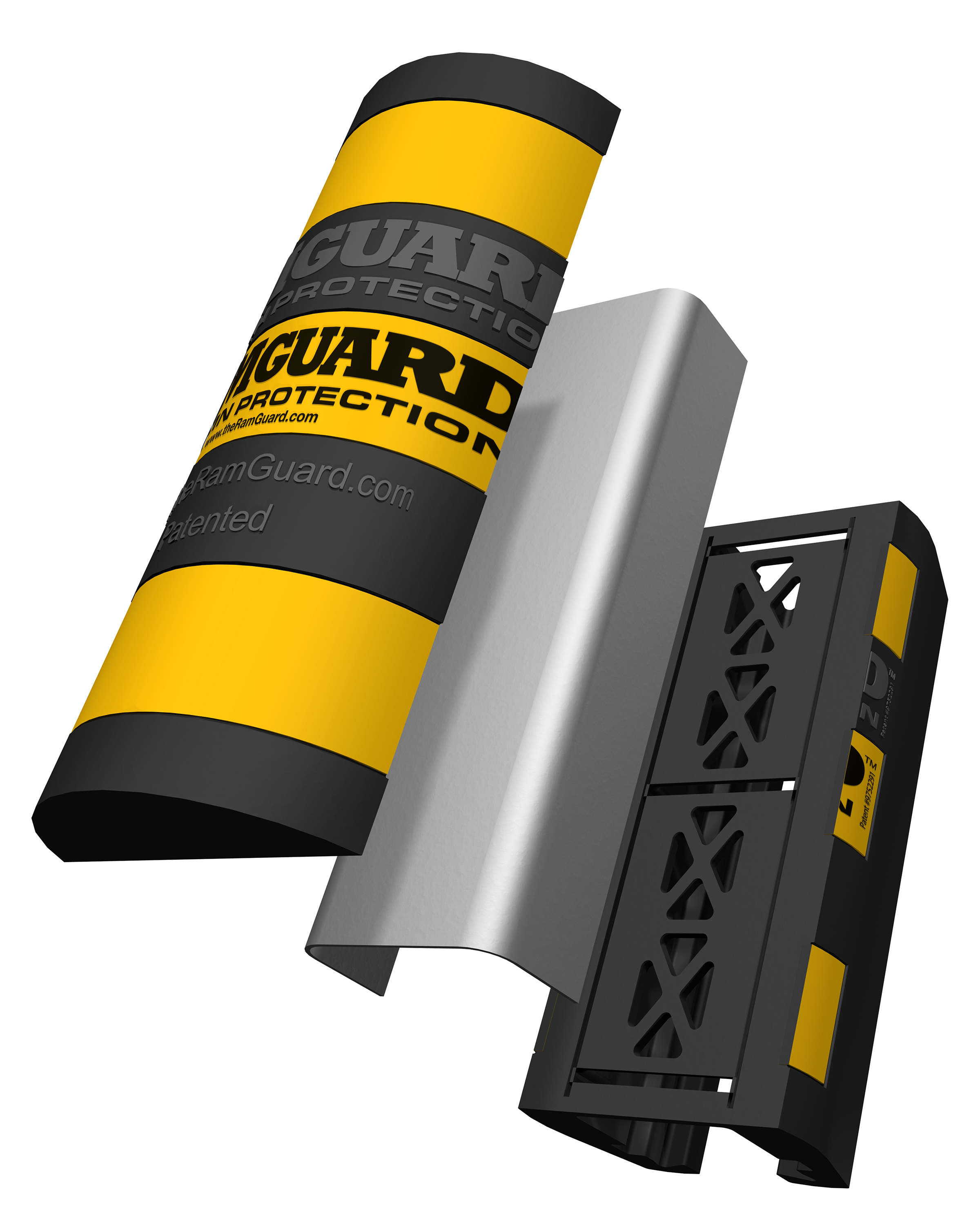
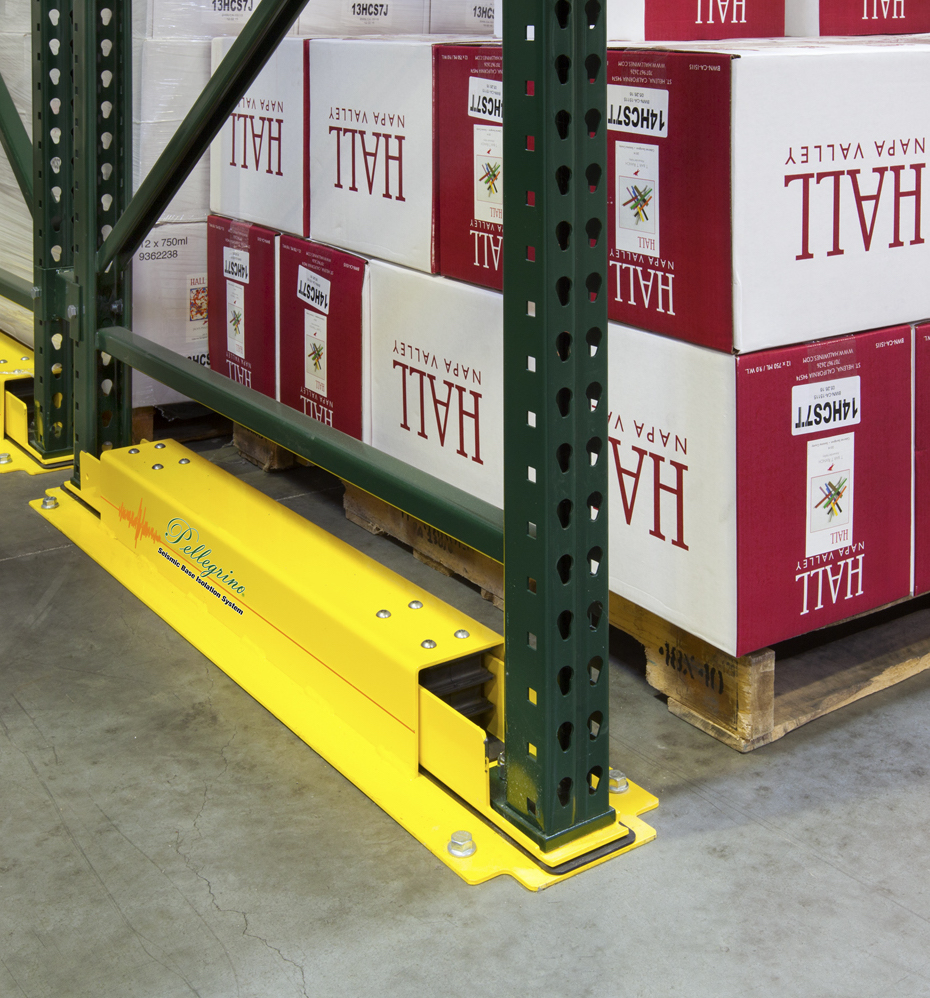
When a forklift collides with a rigid floor-mounted post guard, the guard functions as a vertical lever arm. A strike at 18 inches above the floor multiplies the moment of force transmitted to the 1/2" or 3/4" concrete anchor bolts. In non-reinforced warehouse floor slabs, this sudden shear force routinely causes concrete cratering, spalling, and pull-out. Once the slab is fractured, the anchor point is destroyed. To eliminate this issue, Ridg-U-Rak Storage Systems Inc. engineered the RAMGuard™ system. By clamping directly around the structural upright with shock-absorbing vulcanized rubber and high-strength ductile brackets, RAMGuard dissipates collision energy along the column profile itself, completely avoiding floor drilling and slab spalling.
Can Ridg-U-Rak steel rack column guards be retrofitted to other manufacturer rack systems?
Yes. Both our structural steel free-standing protectors and our patented RAMGuard units are engineered for universal retrofit compatibility. RAMGuard is available in 3-inch, 4-inch, and 5-inch wide configurations with adaptable column-clamping hardware, allowing seamless installation on standard roll-formed teardrop, slotted, structural C-channel, and foreign upright profiles across existing facilities without hot work or drilling.
How do steel column guards perform in cold storage and blast freezer environments?
Freezer facilities (-10°F to -25°F) pose unique hazards: condensation ice creates slippery braking surfaces, and standard commercial plastics become extremely brittle, shattering upon minor impacts. Ridg-U-Rak's steel column guards are fabricated with fine-grain American structural steel that maintains ductile toughness and notched-impact properties at sub-zero temperatures. Furthermore, the specialized synthetic elastomer core of our RAMGuard line is formulated to retain flexibility and energy absorption in extreme freezing environments.
What impact energy rating (in Joules or ft-lbs) is recommended for pallet rack upright guards?
While U.S. building codes focus primarily on the integrity of the rack structure itself, international standards like European EN 15512 and FEM 10.2.02 establish clear benchmark criteria: an upright column guard must be capable of absorbing at least 400 Joules (approx. 295 ft-lbs) of kinetic energy in both lateral and frontal vectors at a height of 400 mm without causing permanent plastic deformation to the underlying column. Ridg-U-Rak heavy structural steel channel guards easily surpass these minimum benchmarks, handling heavy industrial fleet operations.
How does installing heavy-duty steel rack protection affect warehouse insurance and OSHA audits?
Under OSHA 29 CFR 1910.176(a), warehouse operators are legally required to maintain secure aisles and prevent material storage hazards that could cause structural collapse. Deflected or twisted columns represent immediate OSHA citations and can trigger mandatory shutdown orders. Installing certified steel column guards provides physical evidence of risk prevention. Moreover, leading commercial property and casualty underwriters offer lower catastrophic risk premiums and fewer underwriting exclusions when certified, impact-tested column protection is documented throughout the facility.
How to choose between column-attached and floor-mounted guards in Very Narrow Aisle (VNA) systems?
In Very Narrow Aisle (VNA) configurations, floor clearance is constrained by wire or rail guidance lines and turret-truck base frames. Floor-anchored structural channel guards usually require a wide base plate that encroaches 3 to 4 inches into the aisle, risking truck hang-ups. For VNA operations, column-attached low-profile guards or the RAMGuard system are strongly recommended: they add less than 1/2" of clearance to the frame face while maintaining maximum impact resilience.
What finish options provide the longest service life in corrosive or washdown facilities?
Ridg-U-Rak applies a high-durability, electrostatically applied polyester powder-coat finish cured at high temperatures to provide scratch resistance, chemical barrier protection, and high-visibility Safety Yellow aesthetics. For washdown food-processing rooms or chemical staging environments, we offer hot-dip galvanizing per ASTM A123, providing decades of cathodic rust protection in 100% humidity environments.