1. Pitch Calibration and Pallet Interface
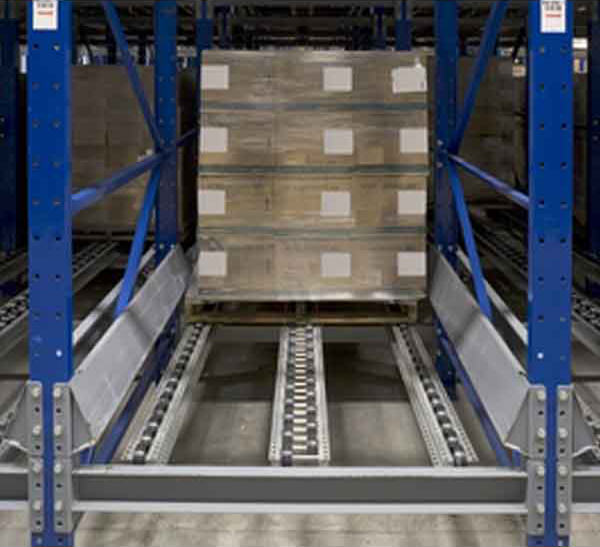
The core mechanical force behind a gravity flow rack is kinetic gravity, controlled via calculated slopes ranging between 3/8-inch and 1/2-inch drop per foot. If the pitch is too shallow, inconsistent GMA, plastic, or perimeter base pallets will stall mid-lane; if the pitch is too aggressive, impact forces against front stops escalate exponentially. Ridg-U-Rak engineers evaluate pallet weight ranges (typically 500 to 3,000+ lbs), runner orientations, bottom-board nail protrusions, and deflection variables before defining track spacing and wheel profiles.
2. Centrifugal and Magnetic Speed Retarders
In deep-lane configurations exceeding 3 pallets, accumulating rolling momentum poses major product safety hazards. Ridg-U-Rak integrates internal gear-driven centrifugal brake rollers or frictionless eddy-current magnetic speed controllers into the track layout. These self-energizing components govern pallet velocity to a controlled 30-to-50 feet per minute, protecting sensitive packaging, bottled liquids, and perishable foods from terminal velocity shock.
3. Automatic Pallet Separators and Pressure Relief
When multiple pallets rest in a pitched lane, their combined gravitational force transfers directly to the front discharge pallet, a phenomenon called hydrostatic line pressure. In a 10-deep lane, extracting a 2,000-lb load against 18,000 lbs of accumulated backpressure can cause dangerous beam binding, product spillage, or premature forklift mast wear. Ridg-U-Rak incorporates heavy-gauge mechanical and pneumatic pallet separators. The separator physically holds back upstream pallets 6 to 12 inches behind the discharge stop until the front pallet is completely cleared by the operator.