Understanding Earthquake Risk in Industrial Storage
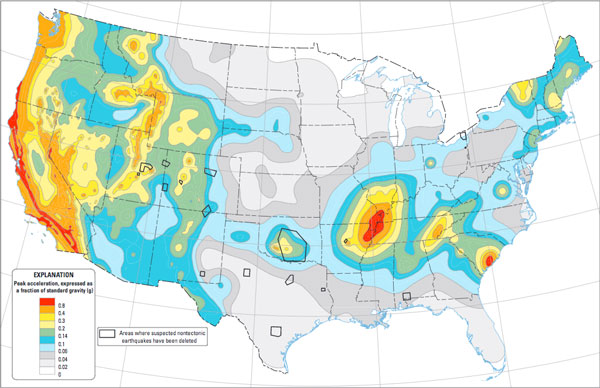
Every parcel of land across North America is categorized by seismic ground motion potential through USGS mapping, NEHRP provisions, and local building codes. In industrial warehousing, ignoring site-specific ground acceleration parameters can lead to catastrophic structural collapse, product loss, and operational shutdown.
Industrial pallet racks are non-building structures governed strictly by ANSI MH16.1, the International Building Code (IBC), and ASCE 7. Because racks carry enormous dynamic mass—frequently reaching twenty to forty feet in height—seismic lateral and torsional forces demand site-engineered upright profiles, robust base plate dimensions, and certified floor anchor embedments.
At Ridg-U-Rak Storage Systems Inc., all storage system quotes incorporate precise geotechnical evaluations matching local municipal requirements across the United States, Canada, and overseas territories.
USGS Seismic Design Hazard Map identifying regional ground acceleration zones across the United States.
The Six Seismic Design Categories (SDC)
Structures are categorized from SDC A through SDC F based on local soil conditions, mapped spectral accelerations, and structural risk classification.
Minimal Ground Acceleration
Regions with historically low vulnerability to seismic disruption. Upright engineering focuses predominantly on gravity static load combinations, standard base anchoring, and standard bracing configurations.
Intermediate Ground Motion
Requires professional engineering validation per ANSI MH16.1. Increased anchor bolt embedment, heavier upright base plates, and verified frame horizontal-diagonal bracing patterns become mandatory.
Severe Ground Shaking
Encompasses extensive areas along fault regions. Demands full structural calculations, heavy-gauge steel uprights, oversized footpads with dual concrete anchors, and validated beam connector locking pins.
Fault Proximity & Essential Use
Structures located near active fault lines or designated as emergency essential facilities. Requires maximum structural ductility, specialized engineering review, or base isolation systems to prevent destructive resonance.
Authoritative NEHRP & ASCE 7 Engineering Framework
Independent of construction quality, no two facilities share identical seismic vulnerability. Factors defining structural risk incorporate the exact spectral response accelerations (Ss and S1), the geotechnical Soil Site Class (Class A hard rock through Class F liquefiable soil), and the building occupancy category. As the Seismic Design Category increases from A to F, structural detailing costs and technical strength margins escalate proportionally.
The Pellegrino Seismic Base Isolation System
For warehouse facilities situated in severe seismic categories or operations storing high-value, hazardous, or fragile materials, conventional anchoring methods transfer intense kinetic energy directly upward into the rack framework.
The patented Pellegrino Seismic Base Isolation System introduces an engineered mechanical interface between the rack column and concrete foundation. During a seismic tremor, the isolator bearings allow controlled multidirectional displacement, effectively decoupling the storage rack from violent ground shock waves.
- Reduces Destructive Force: Absorbs and dissipates up to 85% of lateral seismic forces before they reach load beams.
- Prevents Pallet Ejection: Prevents dynamic shedding of pallets, shielding warehouse workforce and valuable inventory.
- Eliminates Foundation Fracture: Diminishes severe shear pull-out stresses exerted on concrete warehouse floor slabs.
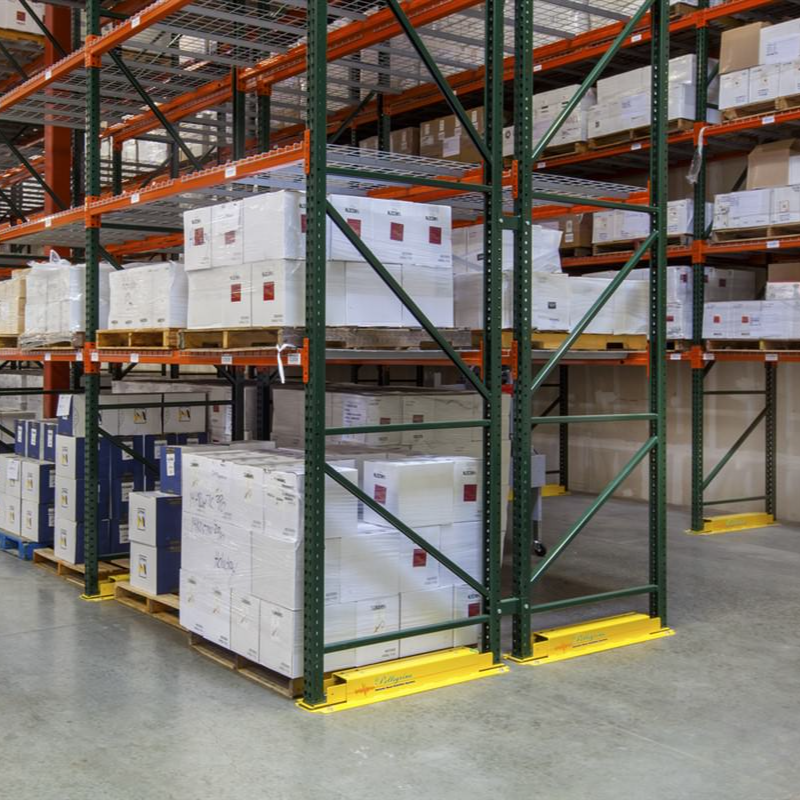
Isolator Assembly In Position
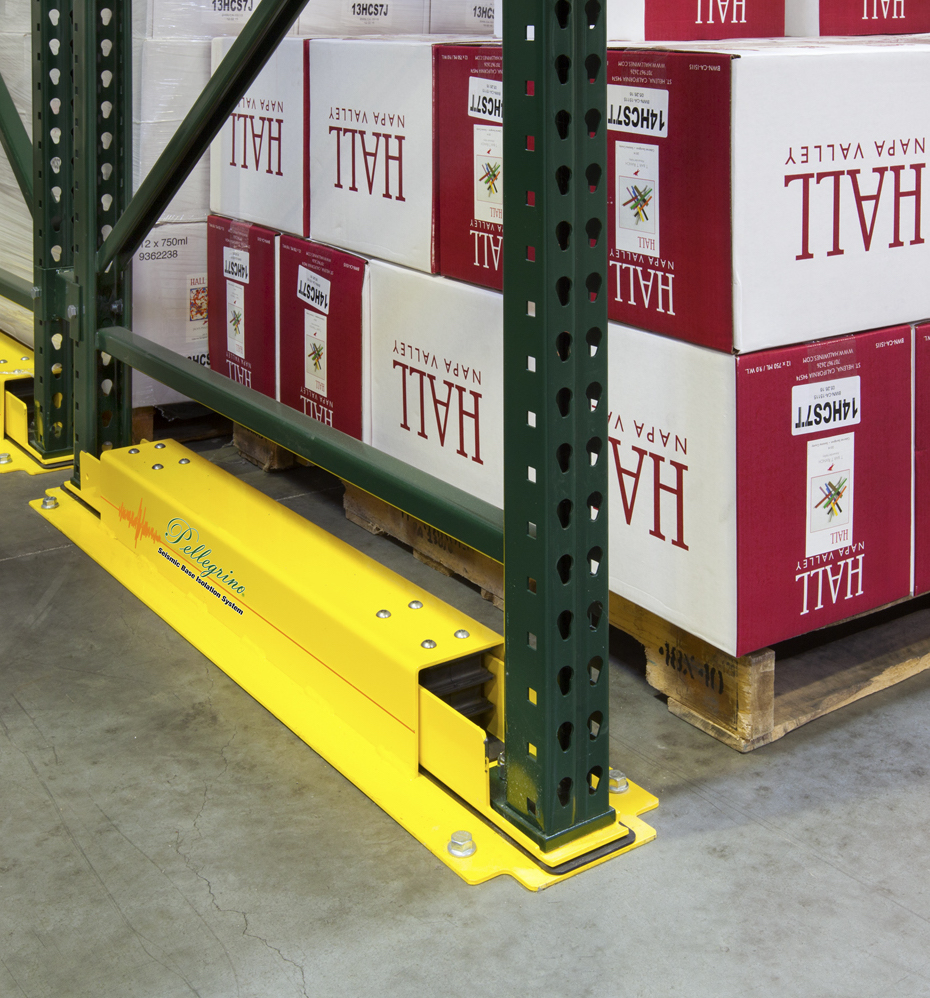
Decoupled Base Plate Mechanism
“We evaluated the extreme risks associated with earthquakes in California and realized that conventional storage rack designs left our facilities exposed. We felt the investment in the Base Isolators provided an extra level of protection for our valuable wines, making it an easy decision.”HALL Wines — Shipping & Inventory Management
Authoritative Engineering References
Industry standard resources and regulatory frameworks utilized by our structural engineering team.
ANSI MH16.1 Specification
The national consensus standard established by the Rack Manufacturers Institute (RMI) for the design, testing, and utilization of industrial steel storage racks under dynamic and gravity loads.
USGS Geotechnical Database
United States Geological Survey unified hazard mapping delivering site-exact ground motion acceleration parameters essential for stamped engineering submittals and permit approvals.
FEMA & NEHRP Provisions
Federal Emergency Management Agency guidelines detailing progressive structural mitigation concepts, non-building structure ductility verification, and life-safety preservation standards.
Prepare Your Storage Facility for Strict Seismic Compliance
Contact the engineering department at Ridg-U-Rak Storage Systems Inc. to evaluate your facility location, obtain stamped professional engineer calculations, or review custom base isolation specifications.