Engineered Industrial Rack Systems for Heavy-Duty Warehousing
Manufactured under stringent cold-roll forming tolerances, robotic laser welding, and high-adhesion thermoset powder coating for international distributors, 3PL aggregators, and manufacturing plants.
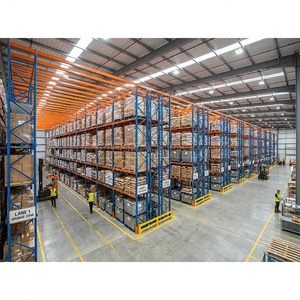
1000kg Drive-In Pallet Rack Warehouse Storage Shelves Units
- Load Capacity: 1000 kg / pallet
- Steel Grade: Q235B / Q355B
- Storage Type: FILO / FIFO Cold Store
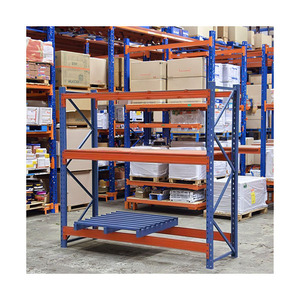
Selective Pallet Racking Modular Steel Distribution Rack 2000kg
- Load Capacity: 2000 kg / beam level
- Pitch Adjustment: 50mm / 75mm Increments
- Structure: Omega Upright + Step Beam
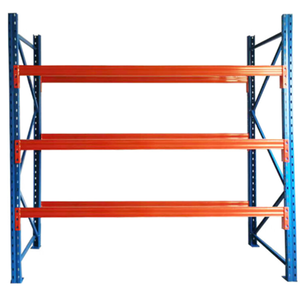
Mracking Industrial Warehouse Pallet Racking Shelving System
- Configuration: Multi-Tier Mezzanine / Rack
- Finishing: Epoxy Electrostatic Powder
- Applicability: General Cargo & E-commerce
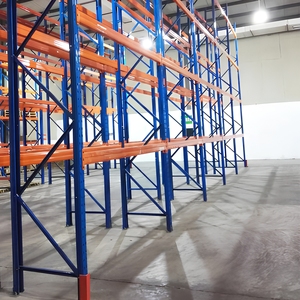
Wholesale Heavy Duty Adjustable Multi-Level Warehouse Rack 1000-3000kg
- Span Range: Up to 3900mm Clear Width
- Section Factor: Reinforced Box/Twin C-Beam
- Safety Index: 1.5 Safety Factor (FEM Standard)
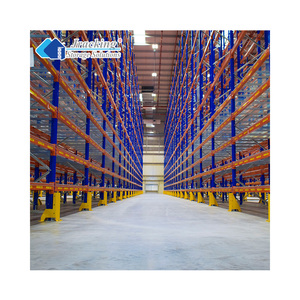
Metal Q355B 50mm Pitch EURO Pallet Rack for Industrial Storage
- Standard: EN 15512 / FEM 10.2.02 Compliant
- Material: High-Tensile Baosteel Q355B
- Compatibility: 1200x800 Euro Pallet Geometry
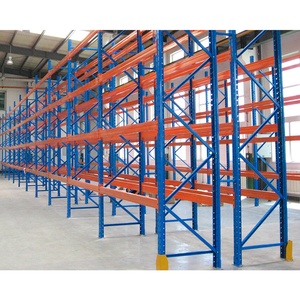
Customized Pallet Rack with Integrated Safety Barrier & Deflectors
- Protection: Heavy Gauge Column Protectors
- Locking System: Spring Lock Safety Pins (Auto)
- Base Engineering: Seismic Anchor Footplates
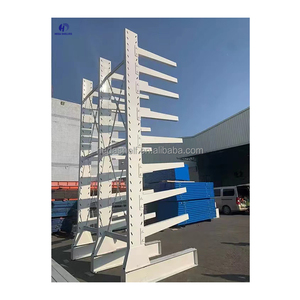
Heavy Duty Cantilever Material Racking for Rebar, Pipe & Timber
- Arm Capacity: 500 kg - 1500 kg per Arm
- Arm Structure: Tapered Welded & Bolted Types
- Application: Long-Bar Stock & Extrusions
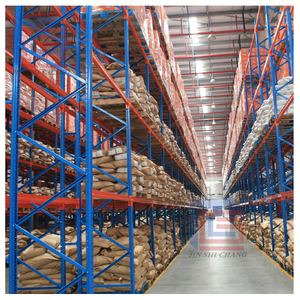
Manufacturer Direct Steel Selective Pallet Storage Framework
- Height Maximum: Up to 12.8 Meters Clear Height
- Surface Coating: Outdoor Galvanized or Powder Coat
- Turnaround: Rapid 14-21 Day Container Loading
Request Full Engineering Load Calculators & Structural CAD Drawings
Are you sizing an international logistics hub or bidding on regional distribution center tenders? Download our structural engineering tables, section modulus details, and complete factory wholesale volume discount scales.
Structural Engineering & Operational Fitment Analysis
System selection hinges on spatial cube utilization, fork truck mast envelope constraints, pick access selectivity, and localized seismic risk zone coefficients ($S_s, S_1$).
| Racking Typology | Direct Selectivity | Cube Utilization | Handling Asset Suitability | Primary Failure Modes | Typical Payload Rating |
|---|---|---|---|---|---|
| Selective Pallet Rack (50/75mm Pitch) | 100% Immediate | 40% - 50% Spatial Eff. | Counterbalance, Reach Trucks | Front Column Impact, Beam Deflection | 1000 - 4000 kg / level |
| Drive-In / Drive-Through Systems | Low (Lane FILO/FIFO) | 75% - 85% Spatial Eff. | Counterbalance, Narrow Chassis | Cantilever Rail Torsion, Upright Rubbing | 1000 - 1500 kg / pallet |
| Heavy-Duty Cantilever Racking | 100% Linear Frontage | 60% - 70% Linear Eff. | Side Loaders, 4-Way Combilifts | Arm Root Moment Shear, Column Buckling | 500 - 2500 kg / arm |
| Multi-Tier Mezzanine Rack Systems | 100% Hand Picking | 90% Vertical Volume | Vertical Reciprocating Conveyors (VRC) | Decking Point Overload, Joist Deflection | 300 - 800 kg / sq. meter |
| Very Narrow Aisle (VNA) High-Bay | 100% High Velocity | 65% - 75% Spatial Eff. | Wire/Rail Guided Turret Trucks | Floor Settlement Tilt, Mast Sway Clearance | 1000 - 2000 kg / pallet |
Why Global Wholesalers & EPC Engineers Partner With Our Facilities
Bridging competitive Chinese steel mills with North American and European structural safety standards through advanced manufacturing integration and end-to-end trace verification.
Direct Mill Certified Prime Steel
Every batch of our uprights and box beams is manufactured from primary-smelt hot-rolled coils from Baosteel, Shougang, or HBIS. We do not source re-rolled structural scraps. Full 3.1 Mill Test Certificates verifying Yield Strength ($R_{eH} \ge 355\text{ MPa}$), Tensile Strength ($R_m$), and elongation percentages accompany every container shipment.
Continuous Cold Roll-Forming Lines
Our workshop houses 18 automated rolling lines with high-precision progressive dies. Uprights are cold-formed through up to 24 roll stations to ensure uniform molecular density along corners, preventing microscopic micro-fracturing along the bends and retaining structural stiffness under extreme seismic and dynamic shock loadings.
5-Stage Surface Pre-Treatment & Coating
Rust prevention begins with automated chemical degreasing, zinc phosphate passivation, and high-pressure deionized rinsing. We deploy Swiss Gema electrostatic powder spray cabins with AkzoNobel or Tiger thermosetting polyester powders, guaranteeing cured dry film thicknesses of 60–80 microns and surpassing 500-hour ASTM B117 salt spray ratings.
Engineering Design by FEM & ANSI Standards
Our in-house structural engineers employ ANSYS and SAP2000 to perform Finite Element Method (FEM) analysis on complex storage geometries. We calculate frame buckling coefficients, semi-rigid beam-to-column connector moment rotations ($K_i$), and seismic ground acceleration responses per RMI MH16.1, AS 4084-2023, and EN 15512 specifications.
Optimized Ocean Container Packing Plans
Damage during ocean voyages represents an unhedged wholesale liability. Our dedicated logistics team creates custom container loading plans using 3D spatial software. Heavy upright bundles are secured on structural steel runner channels, and beams are interleaved with protective corrugated spacer pads and tensioned polyester strapping to ensure zero transit deformation.
Rigorous OEM/ODM Technical Support
We provide full white-label fabrication support for overseas storage rack manufacturers, system integrators, and rack distributors. From customized punch hole configurations (teardrop, slotted, hex, diamond) to branded load capacity labels and third-party certified structural testing reports, our engineering office functions as your direct off-site manufacturing arm.
Strategic Market Vectors: Future Industrial Rack Procurement (2025–2030)
The commercial warehousing environment is shifting rapidly from manual forklift pick-and-pack stations to automated, dense, and ecologically footprinted distribution facilities. Procurement directors managing regional supply chains or enterprise warehousing infrastructures must align their procurement criteria with four dominant transformation vectors:
1. Structural Adaptability for Autonomous Mobile Robots (AMR) & Automated Storage Retrieval Systems (ASRS)
Traditional static racking assumes human forklift operator margins of error ($\pm 50\text{mm}$). Automated guided systems and high-density 4-way pallet shuttle systems demand deflection limits stricter than $L/200$ (often $L/400$ or $L/500$) and rail leveling tolerances tighter than $\pm 1.5\text{mm}$. Warehouses are ordering modular rack uprights pre-punched with universal mounting apertures that allow conventional selective racks to be converted into high-density shuttle bays without cutting or field welding on site.
2. Micro-Alloyed High-Strength Low-Alloy (HSLA) Steels
Escalating ocean freight and cross-border transport expenses have elevated weight optimization into a core cost variable. By shifting from standard structural carbon steel (Q235B equivalent to ASTM A36) to micro-alloyed niobium-vanadium treated Q355B (equivalent to ASTM A572 Grade 50) and Q420 grades, rack engineering achieves equivalent load profiles while decreasing total steel mass by 12% to 18%. This mass reduction cuts dead-weight floor loading on warehouse slab foundations and boosts maritime container shipping density.
3. Resilience in Extreme Temperature Cold-Chain Hubs
Global demand for pharmaceutical distribution and quick-turn frozen foodstuffs requires deep-freeze storage frameworks operating down to $-30^\circ\text{C}$. At these operating temperatures, conventional carbon steel exhibits ductile-to-brittle transition risk, where micro-defects propagate into sudden fractures under dynamic impact. Modern procurement demands Charpy V-notch impact verified steel ($27\text{ Joules at }-20^\circ\text{C}$ or $-40^\circ\text{C}$), paired with anti-condensate epoxy powder formulations designed to resist osmotic moisture blistering during rapid defrost cycles.
4. Lifecycle Decarbonization and Circular Recyclability
Multinational brand owners are mandating Scope 3 emissions reductions from their tier-one supply vendors. Steel processing is one of the highest contributors to industrial carbon output. Chinese rack manufacturers integrating electric arc furnace (EAF) recycled scrap steel, closed-loop zero-discharge chemical pretreatment tanks, and zero-VOC electrostatic powder systems offer wholesalers a decisive bidding edge in ESG-mandated infrastructure tenders across Europe, the Americas, and Australasia.
Technological Advancements in Storage Rack Fabrication
The structural integrity of pallet storage racking depends on cold-formed thin-walled steel profiles working in conjunction with semi-rigid hooked connector locks. Recent advances across Chinese manufacturing facilities have transformed quality consistency:
- Adaptive Closed-Loop Roll-Forming: Optical laser gauge sensors measure cross-sectional profile thicknesses in real-time, instantly adjusting roll-die hydraulics to maintain profile straightness within 1/1000 of column height.
- Multi-Axis Robotic Welding Cells: Automated welding stations execute high-integrity gas-shielded fillet welds joining connector claws to box beams, eliminating cold-lap defects and irregular weld penetration common in manual operations.
- Full-Scale Physical Portal Frame Testing: Validation using automated pneumatic load testing jigs that subject multi-bay rack configurations to cyclic lateral sways, verifying frame stiffness and connector moment curves ($M-\phi$) in strict alignment with EN 15512:2020 Annex A protocols.
Frequently Asked Questions: Global Industrial Rack Sourcing
Direct technical answers addressing international engineering compliance, material specifications, ocean shipping protection, and factory wholesale operations.
Q What steel specifications are used, and can you provide mill test certificates?
Our standard heavy-duty structural components are fabricated from certified prime Q235B and Q355B hot-rolled carbon steel coils sourced directly from top-tier Chinese state mills (Baosteel, Shougang). We supply original EN 10204 Type 3.1 Mill Test Certificates with every production batch, detailing chemical composition (carbon, manganese, phosphorus, sulfur) and mechanical properties (yield point, ultimate tensile strength, elongation).
Q How do you engineer racks for seismic zones (e.g., California, Chile, New Zealand)?
Seismic rack engineering requires site-specific calculations. We account for your facility’s Seismic Design Category (SDC), spectral acceleration values ($S_s, S_1$), and soil site classification per ASCE 7 / IBC or Eurocode 8. Based on these seismic coefficients, we increase baseplate surface thickness, integrate heavy-duty wedge or chemical anchor arrays, and deploy structural horizontal and vertical K- or X-bracing along the spine and upright frames.
Q What is the standard beam deflection limit under safe working load (SWL)?
In adherence with ANSI MH16.1 and FEM 10.2.02 / EN 15512 specifications, maximum allowable vertical deflection of our loaded pallet beams does not exceed $L/200$ (where $L$ is clear beam span length) under uniformly distributed load (UDL). When integrating with automated turret trucks or ASRS shuttles, we engineer beam sections to stricter deflection thresholds of $L/300$ or $L/400$.
Q Can you manufacture teardrop or slotted profiles compatible with US/European brands?
Yes. We operate tooling sets for conventional North American teardrop hole patterns (compatible with major US brands), European 50mm pitch metric slotted uprights, 75mm Australian pitch configurations, and 76.2mm international imperial styles. We can supply matching replacement uprights, replacement beams, or complete custom-engineered systems that interface directly with your existing warehouse footprint.
Q How is the powder coating tested for corrosion resistance and adhesion?
Our in-house quality control laboratory performs continuous testing on coated test coupons from each shift. Testing protocols include Cross-Cut Adhesion Testing (ISO 2409 / ASTM D3359 Grade 4B/5B), Impact Resistance testing (50 cm direct falling ball without flaking), pencil hardness ($\ge 2\text{H}$), and continuous ASTM B117 salt spray exposure testing (500+ hours with zero blister propagation along score lines).
Q How many metric tons or pallet locations fit into a standard 40ft High Cube container?
Because rack uprights and beams are high-volume, relatively heavy items, container loading depends on whether the shipment reaches the road-weight ceiling or volumetric capacity first. A typical 40ft HQ container can accommodate approximately 22 to 26 metric tons of steel racking. For standard selective pallet racking, this equates to roughly 800 to 1,400 pallet locations, depending on clear height, beam lengths, and payload weight per bay.
Connect Directly with Our Structural Engineering & B2B Wholesale Team
Submit your warehouse AutoCAD floor plans, pallet load specifications ($W \times D \times H$), and seismic parameters. Our engineering department will deliver an optimized structural layout, certified load calculations, and a factory FOB/CIF commercial quotation within 48 business hours.