Engineered Industrial Pallet Racking & Specialized Storage Systems
Manufactured from certified high-tensile Q235B and Q355B structural steel, our storage systems deliver certified load capacities up to 4,000 kg per beam level. Explore our primary manufactured product series below.
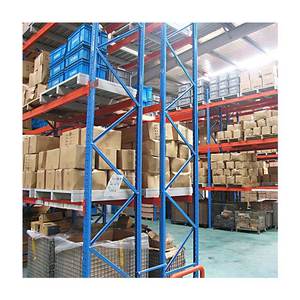
Industrial Heavy Duty Warehouse Storage Pallet Rack
Heavy-duty roll-formed selective racking with teardrop or slotted upright patterns, customizable upright depths, and 50mm-76.2mm beam adjustability.
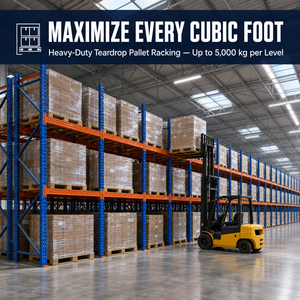
Large Scale Logistics Pallet Racking System
Engineered for high-throughput fulfillment centers requiring rapid SKU replenishment, multi-tier picking levels, and seismic dynamic stability.
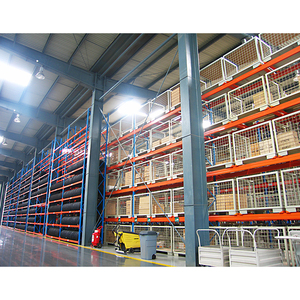
CE Certified Heavy Duty Industrial Selective Racks
Manufactured in full conformity with European Standard EN 15512. Finished in high-adhesion electrostatic thermosetting epoxy powder coating.
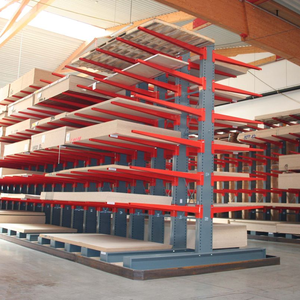
Heavy Duty Steel Cantilever Racking System
Column-and-arm architecture eliminating front-column restrictions for lumber, steel pipes, extruded aluminum profiles, and bar stocks.
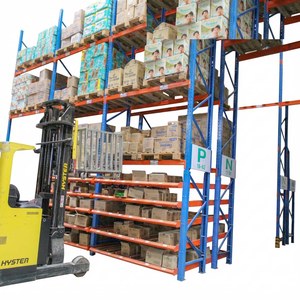
Boltless Heavy-Duty Industrial Garage & Warehouse Shelving
Interlocking beam and rivet design engineered for fast modular assembly without hardware. Ideal for carton handling and parts picking.
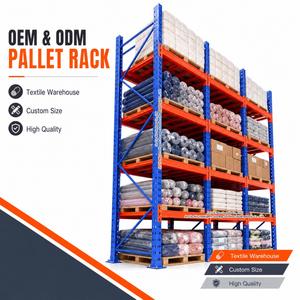
4-Level Industrial Heavy Duty Pallet Shelving
Reinforced roll-formed box beams and wire mesh decking designed for high-density rolls, raw garment textiles, and heavy manufactured components.
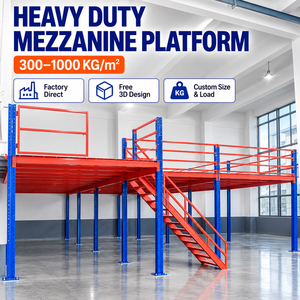
Heavy Duty Rack-Supported Steel Mezzanine Floor
Multi-tier structural platform utilizing heavy-duty upright frames as vertical support to double or triple usable clear-height square footage.
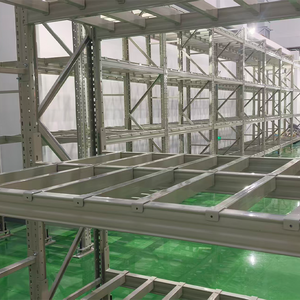
Thickened Industrial 2000kg+ Pallet Racking System
Equipped with 2.0mm to 2.5mm heavy-gauge columns, seismic-resistant heavy-duty footplates, and dual-flange welded step beams.
Structural Metallurgy, Cold-Roll Forming, and Seismic Load Dynamics
In modern industrial storage design, pallet racking can no longer be evaluated merely as passive steel shelving. In an era of high-bay distribution centers exceeding 30 meters in clear height, seismic-governed structural design, and automated guided vehicle (AGV) integration, a pallet rack system operates as an engineered structural skeleton. Sourcing directly from an established Chinese manufacturer provides significant economies of scale, but procuring logistics infrastructure requires an uncompromised understanding of structural yield strength, buckling failure modes, weld penetration integrity, and corrosion protection chemistry.
At our manufacturing facility, the structural foundation of every upright profile and beam begins with high-grade hot-rolled coil (HRC) steel sourced from prime domestic mills including Baosteel and Shougang. We primarily utilize Q235B (yield strength ≥ 235 MPa, tensile strength 370–500 MPa) for light-to-medium uniform load profiles, and Q355B (yield strength ≥ 355 MPa, tensile strength 470–630 MPa) for high-bay upright columns, heavy-duty drive-in cantilever arms, and elevated multi-tier mezzanine columns. Every batch of coil receives chemical composition testing (carbon, silicon, manganese, phosphorus, sulfur) and mechanical tensile testing before entering our continuous roll-forming lines.
The manufacturing process employs 24-station continuous roll-forming mills that gradually shape cold steel sheet into complex 6-bend and 8-bend open column profiles without inducing micro-fracturing along the outer bending radii. Precise continuous punching is conducted by fully automated CNC hydraulic punch presses synchronized with optical encoders, ensuring pitch consistency within ±0.05 mm across standard 50mm, 75mm, and 76.2mm (3-inch North American teardrop) hole configurations. This tight tolerance eliminates binding during field beam clip insertion and prevents eccentric beam load transfer under heavy dynamic operations.
Full Lifecycle Manufacturing Rigor: From Coil to Finished System
How our vertically integrated factory guarantees compliance with international safety codes (ANSI MH16.1, EN 15512, AS 4084, and FEM 10.2.02).
Finite Element Analysis (FEA)
Every custom system layout is modeled using ANSYS and SAP2000 FEA software. We simulate axial column buckling, localized shear, beam connection torsional rotation, and seismic acceleration matrices based on project-specific geographic coordinates.
Robotic CO2 Shielded Welding
Beam end connectors and baseplates are joined using automated multi-axis Panasonic welding robots utilizing ER50-6 wire under an 80% Ar / 20% CO2 gas shield. This delivers deep weld penetration, zero spatter, and uniform throat thickness verified by ultrasonic inspection.
9-Stage Pre-Treatment & Powder Coating
Components pass through chemical degreasing, zinc phosphate passivation, and multi-stage deionized water rinsing before electrostatic application of TGIC-free polyester powder cured at 200°C. Provides 500+ hours salt spray corrosion resistance (ASTM B117).
Seismic Dynamic Testing
Our heavy-duty upright frames and base anchoring configurations are tested for inelastic rotational capacity and ductility under cyclic loading protocols. Baseplates are thickened up to 16mm with pre-punched holes for heavy mechanical or epoxy anchors.
Custom Connector Configurations
We manufacture full interchangeability for North American teardrop compatibility, European 50mm pitch patterns, British standard slotted profiles, and heavy-duty bolted structural channel systems to integrate seamlessly into existing warehouse expansions.
Automated Factory Staging & Bundling
Components are pre-drilled, labeled, and bundled with protective corner wrap, corrugated separators, and high-tensile steel strapping. Customized packaging ensures maximized 40ft High-Cube container cube utilization without transit gouging or bending.
Engineering Comparison Matrix: Industrial Pallet Rack Architectures
Compare mechanical footprint, pallet selectivity, density ratios, and material handling equipment (MHE) compatibility to select the optimal structural configuration.
| Racking Architecture | Selectivity | Storage Density | Inventory Rotation | MHE Compatibility | Optimal Application Scenario |
|---|---|---|---|---|---|
| Standard Selective Rack | 100% Immediate | Baseline (Standard) | FIFO / LIFO Flexible | Counterbalance, Reach Trucks | High SKU variety, fast fulfillment, 3PL logistics |
| Very Narrow Aisle (VNA) | 100% Immediate | High (+45% vs Selective) | FIFO / LIFO Flexible | Wire/Rail Guided VNA Turret | High-bay warehouses with constrained floor plate |
| Double Deep Racking | 50% Selective | Medium-High (+30%) | FILO (First-In, Last-Out) | Pantograph / Deep Reach Truck | Multi-pallet SKU batches, dry goods manufacturing |
| Drive-In / Drive-Through | Lane-Level (<15%) | Ultra High (+70%) | LIFO (Drive-In) / FIFO (Through) | Counterbalance, Reach Truck | Cold storage, frozen food, high-volume seasonal SKUs |
| Push-Back Rack (Carts) | Lane-Level (2-6 Deep) | High (+50%) | LIFO Gravity Return | Standard Reach Truck | Moderate turn SKUs where aisle space must be cut |
| Pallet Flow / Gravity Rack | Lane-Level Flow | Ultra High (+75%) | Strict FIFO (Continuous) | Standard Counterbalance | Perishable food, pharmaceuticals, date-sensitive goods |
| Rack-Supported Mezzanine | Multi-Tier Pick | Max Cube (+100-200%) | Flexible Zone Flow | Conveyors, Vertical Lifts | E-commerce manual split-case picking, garment sorting |
Future Procurement Trends & Next-Generation Racking Technologies
Key structural shifts, automation integrations, and sustainability criteria reshaping international warehouse rack procurement over the next decade.
1. Hybrid Automation & Shuttle-Ready Racking
Traditional static storage is transitioning rapidly toward automated radio shuttle systems and four-way multi-directional shuttle platforms. Procurement managers are increasingly specifying dual-purpose racking channels with roll-formed rail profiles that function seamlessly under manual forklift loading today, while allowing plug-and-play installation of automated shuttles tomorrow without costly structural replacement.
2. Structural Cold-Chain Thermal Resilience
With global cold-chain distribution surging, steel selection under sub-zero conditions (−25°C to −40°C) has become a primary engineering gate. Traditional steels suffer from low-temperature notch brittleness. Procurement contracts now mandate impact-tested steels (Charpy V-Notch ≥ 27J at −20°C) and specialized hot-dip galvanized or zinc-rich coatings that resist condensation freeze-thaw corrosion.
3. Integrated IoT Structural Health Sensors
The convergence of industrial internet-of-things (IIoT) and racking is enabling real-time structural health monitoring. Smart strain-gauge sensors embedded within lower column bases detect accidental forklift impacts, frame misalignment, and localized overloading, instantly alerting facility safety engineers via warehouse management software (WMS) dashboards before catastrophic progressive collapse can occur.
4. Decarbonization & Green Steel Auditing
Global corporations operating under Scope 3 emissions mandates now require comprehensive Environmental Product Declarations (EPDs) for fabricated steel structures. Chinese manufacturers operating energy-efficient electric arc furnaces (EAF) and closed-loop powder recovery systems provide audited carbon-footprint documentation, giving international procurement teams a distinct sustainability advantage.
5. Total Cost of Ownership (TCO) Procurement
Savvy procurement teams have evolved past purely evaluating "FOB price per metric ton." Comprehensive evaluation models now analyze container packing density (weight vs. volume balance), field assembly labor speed (modular boltless connections vs. bolted frames), structural interchangeability, and the lifecycle cost of column impact protectors to determine real capitalized return on investment.
6. Global Modular Code Harmonization
Supply chain globalization requires flexible fabrication lines capable of rolling profiles certified simultaneously to ANSI MH16.1 (United States), CSA S16 (Canada), EN 15512 (Europe), and AS 4084 (Australia). Our factory utilizes versatile tooling that meets stringent local structural codes with zero re-tooling lag time.
How to Execute a Direct Factory Procurement Project
A transparent 4-stage engineering and manufacturing pathway ensuring on-spec delivery, permit sign-off, and rapid commissioning.
Site Data & Load Spec Submission
Share your architectural CAD floor plan, slab thickness, concrete compressive strength (f'c), clear ceiling height, pallet dimensions (W x D x H), total gross weight, and local seismic zone coefficients.
Layout Engineering & Stamped FEA
Our engineering team drafts optimal aisle layouts, calculates dynamic clearance tolerances for your specified forklift models, and delivers stamped structural calculations and 3D layout renderings for local permitting.
Precision Roll-Forming & QC Audit
Steel coils are slit, punched, roll-formed, robotically welded, and powder-coated. We provide live third-party inspection access, mill certificates, powder thickness gauge reports, and packaging photos prior to vessel dispatch.
Containerization & Site Commissioning
Components are systematically bundled and packed into 40ft High-Cube containers to eliminate transit movement. We supply bilingual installation blueprints, video guides, or dispatch supervisory installation engineers on site.
Frequently Asked Questions by Overseas Procurement Teams
Clear, definitive technical answers covering engineering certifications, material standards, seismic compliance, and global shipping logistics.
How do your rack designs conform to US (RMI / ANSI MH16.1) and European (EN 15512) standards?
Our structural design department calculates upright capacities, beam deflections, and connection stiffness in direct compliance with ANSI MH16.1 (Specification for the Design, Testing, and Utilization of Industrial Steel Storage Racks) and European Standard EN 15512. For projects in North America, we verify that maximum beam deflection does not exceed L/180 under uniformly distributed load (UDL). In Europe, we comply with limit-state safety factors and serviceability thresholds specified under FEM 10.2.02. Full calculation packages stamped by accredited third-party structural engineers are available for municipal building permit submittals.
What steel grades do you specify, and how is raw material quality verified?
We mandate prime domestic hot-rolled structural coil steel, primarily Q235B (comparable to ASTM A36 / European S235JR) for standard loading and Q355B (comparable to ASTM A572 Grade 50 / European S355JR) for high-load columns and heavy-duty seismic uprights. Each master coil arrives with certified Mill Test Certificates (MTC) showing ladle chemical composition and mechanical properties. Before slitting, our in-house metallurgical laboratory verifies tensile strength, yield point, and elongation percentages via calibrated universal testing machines.
How do you engineer pallet rack systems for high-risk seismic zones?
Seismic design category (SDC A through F under IBC / ASCE 7) dictates frame bracing geometry, baseplate surface area, anchor bolt embedment depth, and beam connector lock capacity. For seismic projects, we utilize enlarged, CNC-drilled baseplates (typically 10mm to 16mm thick) that distribute seismic overturning moments across the floor slab. In addition, we incorporate heavy horizontal and diagonal K-bracing or X-bracing in the rear frames, accompanied by structural seismic row spacers to lock back-to-back rack runs into rigid, energy-dissipating structural diaphragms.
What is the difference between teardrop and structural pallet racking?
Teardrop pallet racking utilizes roll-formed cold-rolled light-gauge steel columns featuring teardrop-shaped punchings that allow boltless, rapid beam engagement with automatic spring-safety locks. It is the dominant standard across North America due to its low tare weight, fast installation, and cost-efficiency. Structural pallet racking is fabricated from hot-rolled C-channel structural steel with bolted beam-to-column connections. Structural rack provides vastly superior resistance against heavy forklift impacts, making it the preferred choice for heavy manufacturing, high-throughput freezer warehouses, and harsh outdoor lumber or steel yards.
How do you optimize container packing to prevent freight damage during ocean transport?
Pallet rack components represent a high-density, heavy freight commodity that easily reaches ocean container weight limits (typically 26 to 28 metric tons per 40ft High-Cube) before volume is exhausted. Our logistics software models each packing order down to the millimeter. Upright frames are nested and banded with heavy corrugated edge protectors, beams are stacked on custom wooden dunnage with steel banding and plastic shrink wrap, and smaller accessories (baseplates, row spacers, shims, safety pins) are packed in heavy-duty wooden crates or steel-strapped pallets. This eliminates shifting and scuffing during multi-week ocean transit.
Can your factory produce custom colors and OEM compatibility for our existing rack inventory?
Yes. Our automated electrostatic powder-coating lines support any RAL color specification to match your corporate identity or safety standards (standard stock configurations feature RAL 5015/5017 Blue uprights and RAL 2004 Orange beams). Furthermore, if you are expanding an existing distribution center containing proprietary European, American, or Australian upright punch profiles, our tooling workshop can custom-mill roll-forming dies and stamping punches to produce fully interchangeable columns, beams, and replacement components.
What documentation and on-site support do you provide for installation?
Every shipment is accompanied by comprehensive engineering drawings, piece-marked component schedules, and a 3D structural installation manual. For enterprise distribution centers, we offer bilingual digital supervisory support via live conference calls, video walkthroughs, and step-by-step laser leveling instructions. Upon request, we can also dispatch factory-certified installation supervisors to your jobsite to lead your local mechanical installation contractor through anchoring, plumb-line verification, and load sign-off.
What is the expected production lead time and FOB/CIF delivery timeline?
Standard orders ranging from 2 to 10 ocean containers typically require a factory production lead time of 20 to 30 days from final approved engineering drawings and deposit receipt. Project tracking is shared weekly with milestone photographs of roll-forming, welding, powder coating, and loading. Ocean transit times vary by destination port (approximately 14–20 days to US West Coast, 28–35 days to US East Coast, 25–32 days to Northern Europe, and 12–18 days to Australia/Middle East).
Ready to Optimize Your Warehouse Capacity & Lower Storage Costs?
Connect directly with our senior intralogistics engineering team. Receive custom CAD layout drawings, finite element load capacity calculations, and a complete factory-direct FOB/CIF price quotation within 24 hours.